.jpg)
Volkswagen Golf 1 Cabriolet, History & Renting in Groningen
The Volkswagen Golf 1 Cabrio – often referred to by enthusiasts and connoisseurs as the Golf Mk1 Cabriolet – is a car that instantly gives many people a warm feeling. It’s a vehicle that takes us back to an era when driving was mechanical, straightforward, and pure. While many classics are mainly admired for their lines, the Golf Cabriolet is loved for its character. A wonderful classic car that you can rent from us in the city of Groningen for a day of touring. The arrival of the Golf 1 marked Volkswagen’s transition from the classic Beetle Cabriolet to the modern era of water-cooled engines and front-wheel drive.
With its distinctive roll bar, compact dimensions, and the timeless design by Giugiaro (refined by Karmann), this car has secured a permanent place in automotive history. At Tonny’s Classic Drive, we notice it every time a renter steps in: this car does something to you. In this in-depth guide, we dive deep into the origin story, the technical evolution, the international career, and the unique driving experience of the car affectionately nicknamed the “strawberry basket.”
At a glance: The Volkswagen Golf 1 Cabriolet
So what are the technical specifications of the Golf 1 Cabrio that you can rent from us? Ours is from model year 1979 and rolled off the production line as one of the very first. For fast fact-finders and true enthusiasts, here are the key details of the Golf 1 Cabrio:
- Production years: 1979 – 1993
- Manufacturer: Wilhelm Karmann GmbH, Osnabrück
- Internal type code: Type 155
- Total production: Approximately 392,000 units
- Major facelift: 1987 (introduction of the ‘Clipper’ kit)
- Predecessor: Volkswagen Beetle Cabriolet
- Successor: Volkswagen Golf 3 Cabriolet
The Origin of the Golf 1 Cabrio: A Heavy Legacy
When Volkswagen decided in the mid-1970s that it was time for a successor to the legendary Beetle Cabriolet, the engineers in Wolfsburg faced a major challenge. For decades, the Beetle had been the undisputed king of open-top cars, loved for its charm and rounded shapes. The successor not only had to be technically superior, but also had to capture the public’s emotions. The introduction of the closed-roof Golf in 1974 – with its transversely mounted engine, front-wheel drive, and straight lines – was already a revolution. The big question was: how do you translate that modern, angular design language into an elegant cabriolet?
The Crucial Role of Karmann
The history of the Golf Cabriolet is inseparably linked to coachbuilder Wilhelm Karmann GmbH in Osnabrück. Karmann was no stranger to Volkswagen; the company had been building the Beetle Cabriolet for decades, as well as the stunning Karmann Ghia. The bond between Wolfsburg and Osnabrück was strong. While Volkswagen itself was busy with producing and further developing the closed Golf 1, Karmann began sketching and developing an open variant based on the Golf on its own initiative in 1976.
Karmann saw the writing on the wall: the Beetle was nearing the end of its life, and with it a large part of their production capacity risked falling idle. They wanted to secure the lucrative cooperation with Wolfsburg for the future. When Karmann presented the first prototype to Volkswagen’s management, the car looked fundamentally different from what we know today: it had no roll bar. Volkswagen’s reaction was mixed. The design certainly had potential, but there was a major obstacle in the way: safety requirements.
The Safety Paradox and the Roll Bar
In the 1970s, a wave of safety awareness swept through the automotive industry, especially in the United States, Volkswagen’s most important export market. There was (looming) legislation that would effectively ban convertibles without roll-over protection. Many manufacturers played it safe and stopped developing open-top cars.
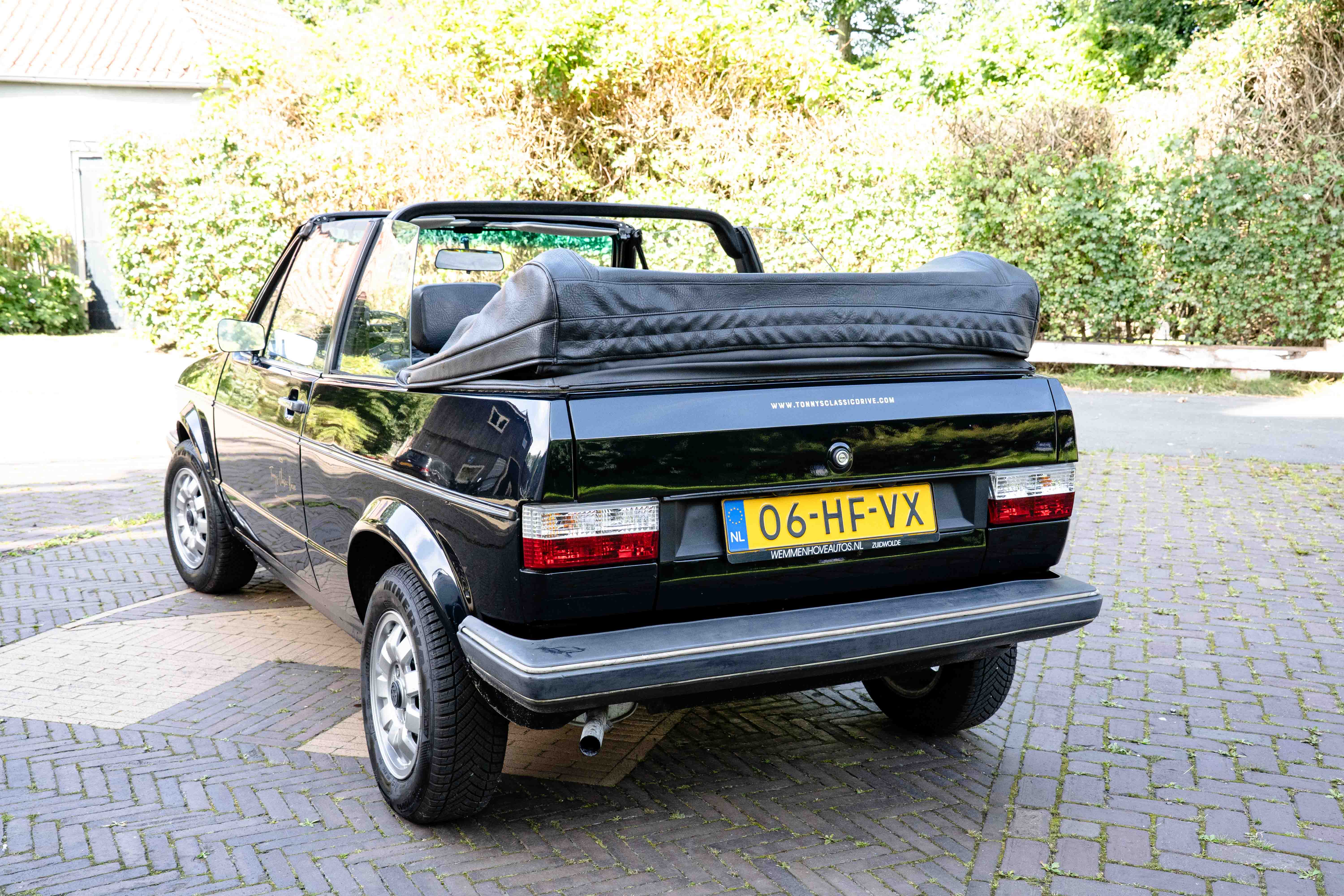
Volkswagen and Karmann chose a different route. To get the project approved, safety became the top priority. The engineers designed the now-famous fixed roll bar over the B-pillar. For Volkswagen, this was the key to keeping the project alive. This construction served multiple purposes:
- Safety: Protecting occupants in the event of an unforeseen rollover.
- Rigidity: The bar connected the sides of the car, improving the body’s torsional stiffness.
- Functionality: It provided a perfect mounting point for the front seat belts and ensured better, quieter guidance of the side windows. What began as a necessary technical intervention ultimately became the car’s most recognizable design feature.
The Launch: “Sun, Moon and Cabriolet”
Production of the Golf 1 Cabriolet (internally designated Type 155) started on February 14, 1979 in Osnabrück. A month later, in March, the car was officially presented to the world press at the prestigious Geneva Motor Show. Sales began in June, and for a short time the car sat in showrooms alongside the very last Beetle Cabriolet models. Volkswagen launched the model with the poetic and telling slogan “Sun, Moon and Cabriolet,” to show that this was a car for every moment of the day.
Why the Golf 1 Cabrio was also called the “Strawberry Basket”
At launch, the public had to get used to it. The car looked completely different from the rounded, lovable Beetle. It was angular, modern, and had that striking bar that broke the line of the open roof. German automotive journalists, who felt the bar was an aesthetic break with the tradition of the “open roadster,” quickly nicknamed the car “Erdbeerkörbchen” (strawberry basket). What started as a mocking nickname soon became a badge of honor worn with pride. The car turned out to be brilliantly put together. While the Beetle Cabriolet was a pre-war design, the Golf Cabriolet delivered a huge leap forward in modernity.
Practical Ingenuity: More than a Toy
Unlike many other convertibles of that era (often two-seaters with hardly any luggage space), the Golf was designed as a fully fledged car.
- 4 seats: It offers seating for four. Although the rear is snug, (especially for short trips or weddings) two adults or children can ride along just fine.
- Luggage space: The car has a lockable trunk. Unique for the time was the fold-down rear seat, allowing even longer items to be carried.
- Daily use: The combination of front-wheel drive and good heating made it immediately suitable for everyday use, all year round.
International Identity: Volkswagen Rabbit and Cabriolet
Because the United States was such a crucial market for Volkswagen, the car gained its own identity there. In America and Canada, the Golf was called the “Volkswagen Rabbit.” The open version was therefore initially sold as the Rabbit Convertible.
When Volkswagen dropped the Rabbit name in the U.S. in 1985 in favor of the name Golf, something notable happened with the open version. There it was simply renamed the Volkswagen Cabriolet, without the “Golf” designation. In the U.S., the car built a very strong brand image as “the Cabriolet,” often associated with a sunny, successful lifestyle.
Technical Mastery: The Soft Top
One of the reasons the Golf 1 Cabriolet is so popular at Tonny’s Classic Drive for rentals – even when the weather isn’t cooperating – is the quality of the soft top. Karmann delivered craftsmanship that was far ahead of its time. The roof consists of no fewer than five layers, carefully constructed for maximum insulation and comfort:
- The outer weather-resistant covering (vinyl or later the high-quality “Sonnenland” fabric).
- A layer of ‘Nessel’ (nettled cloth material) for strength. A 20 mm thick padding of ‘Gummihaar’ (rubber hair), providing insulation and shape retention.
- Another layer of Nessel/nettle material.
- The tight, luxurious headliner on the inside.
Thanks to this construction, the car is surprisingly quiet and well insulated with the roof up. This makes the car, unlike many British or Italian roadsters of the time, genuinely suitable for all seasons. In addition, the top features a heated glass rear window, which keeps rear visibility safe and clear and prevents scratches.
The Evolution of the Golf 1 Cabrio (1979-1993)
One of the most remarkable facts in automotive history is that the Golf 1 Cabriolet outlived the entire production cycle of the Golf 2. When the closed Golf 1 was replaced by the Golf 2 in 1983, Volkswagen faced a choice. The costs of developing a completely new convertible based on the Golf 2 were high, and the ‘Einser’ Cabrio was still selling extremely well.
The decision was made: the Golf 1 Cabriolet stayed in production, alongside the Golf 2 hatchback. As a result, the car remained in production until 1993. We can roughly divide the car’s lifespan into two visual phases, each with its own charm.
Phase 1: The Classic Look (1979 - 1987)
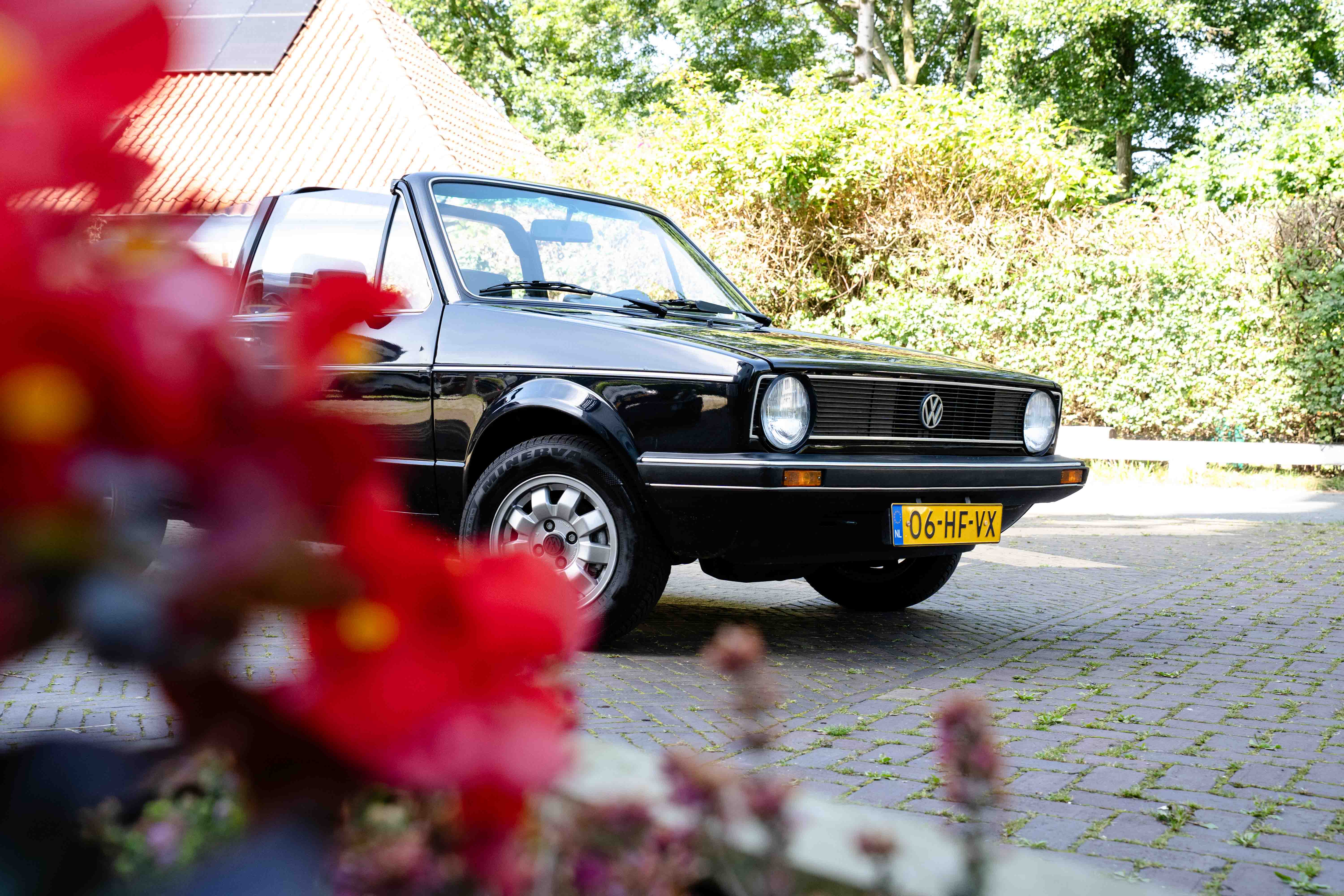
In the early years, the Cabriolet shared its appearance with the early Golf 1. These models can be recognized by the slim metal bumpers with plastic corner pieces and the grille with single or dual headlights. Inside, the very earliest models still featured the iconic dash with deep pods (the so-called “tittentacho”), later replaced by the more modern dashboard.
These early models are closest to Giugiaro’s original design. They look lean, light, and classic.
Phase 2: The “Clipper” Facelift (1987 - 1993)
To visually align the car with the thicker, more modern design language of the late 1980s (and the Golf 2 that was in showrooms), the Golf 1 Cabriolet received a major facelift in 1987.
The car was fitted all around with thick, body-colored bumpers (the so-called Karmann kit), fender extensions, and side skirts. The grille was also updated with larger headlights. This facelift gave the car a “chunkier” and tougher look. For many people, this is the definitive image of the Golf Cabriolet as they remember it from the 1990s.
Technology and Engines of the Golf 1 Cabrio: Myth and Nuance
It’s often said that the Golf Cabriolet “has the GTI chassis.” That is partly true, but it needs some nuance. While the Cabriolet benefited from the advanced Golf-family suspension (McPherson struts up front, torsion beam rear) and, depending on the trim, came with additional anti-roll bars, not every Cabriolet was a sports car.
Engines at a glance
Over the fourteen production years, many different powerplants were offered. A brief overview:
- 1970s/80s Base: 1.5 and 1.6 liter carbureted engines (70–75 hp). Built for relaxed cruising.
- The sporty top: GLI versions with 1.6 or 1.8 liter GTI engines (110–112 hp) and K-Jetronic injection.
- 1990s Modern: The 1.8 liter “2H” engine with Digifant injection and catalytic converter (98 hp).
Especially that last one, the 2H engine, became the standard for the more luxurious models such as the Classic Line. With 98 hp, this engine offered the perfect balance: powerful enough to keep up with modern traffic, reliable, and more environmentally friendly. For anyone renting a car from us, that means a classic that starts, runs, and drives exactly as you hope, without the quirks of very old technology.
Special Editions: A Palette of Nostalgia
Because the car stayed in production for so long, Volkswagen released various “Aktionsmodelle” (special editions) in the later years to boost sales. Precisely these editions are now, years later, fantastic for rentals. They offer variety in style, color, and atmosphere, ensuring there’s a fitting example for every occasion – from weddings to road trips.
Here are the most iconic versions that confirmed the car’s status:
- Etienne Aigner (1990): Designed in collaboration with the luxury accessories and leather goods brand Etienne Aigner. These models are very chic and recognizable by specific metallic paints (Midnight Blue, Bordeaux Red, or Mangrove Green). The interior features fabric with Aigner’s horseshoe logo and matching top covers. A symbol of good taste.
- Classic Line (1991-1993): Often seen as the ultimate “farewell version” and very popular as a wedding car. The style is pure elegance: dark green, dark blue, or black metallic, standard with beige or black leather upholstery. Often equipped with the beautiful forged ‘Le Castellet’ aluminum wheels and an electrically operated roof.
Genesis (1992): Released to celebrate sponsorship of the European tour of the band Genesis (with Phil Collins). Finished in a unique purple shade (“Violet Touch Pearl”) and a then-advanced sound system. The upholstery has a specific, colorful pattern. - Sportline (1991-1993): The sporty brother of the Classic Line. Delivered in red or black, with black BBS wheels, a slightly lowered suspension, and an interior with Recaro sport seats and red instrument needles.
- Quartett: This was not a limited edition, but a version where buyers could mix and match the color of the roof, the interior, the bumpers, and the paint (in white, blue, red, or black). This resulted in the most typical 1980s combinations.
Other editions: Think of the Fashionline, Toskana, Acapulco, and the Bel Air. Each with their own unique details and color schemes.
Why Rent Our Golf 1 Cabrio in Groningen?
The numbers, years, and editions only tell half the story. What really matters at Tonny’s Classic Drive is the driving experience behind the wheel and the overall feeling. Our classic-car collection – and most of them are convertibles – is ideal if you want to tour through Groningen in a classic car. Or if you want to rent a wedding car for your big day. But… what does it feel like to drive a Golf Mk1 Cabriolet today?
The Golf 1 Cabrio Has Great Road Feel
Unlike modern convertibles, which often feel heavy and isolated, the Golf 1 offers a direct connection to the road. You sit in the car, not on it. The steering is direct and communicative (often power-assisted on later models; on early models it’s pure muscle work when parking, but light at speed). You feel what the car is doing. A weight of around 950 to 1000 kg makes the car nimble and playful, even with the smaller engines.
The Ritual of the Roof
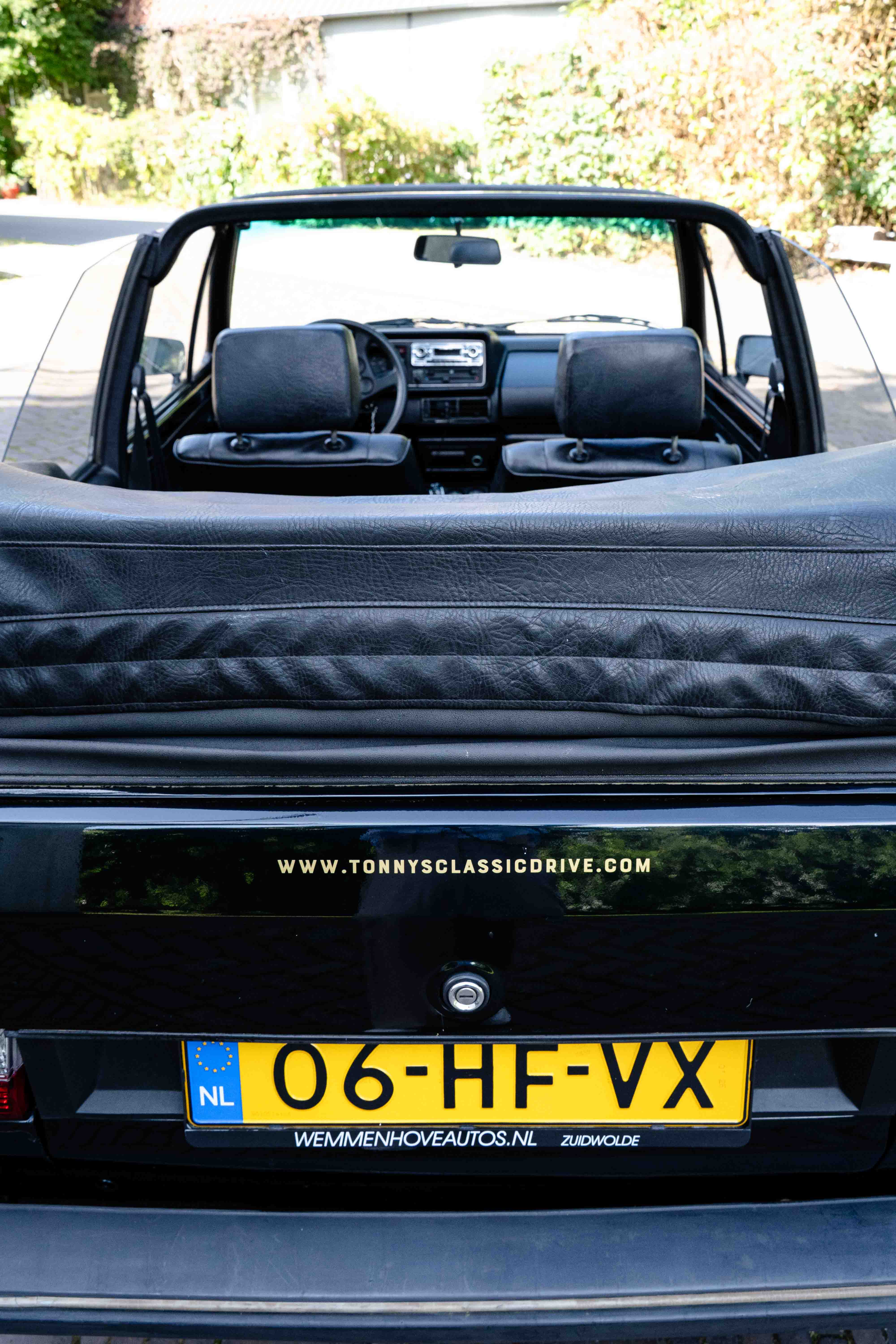
Opening the roof is an experience in itself. On the manual versions (most models), you unlock two latches near the sun visors, push the roof up, and fold it back in one smooth motion. There it folds up like an accordion on the “parcel shelf.” No cover panel is needed, although the “persenning” (top cover) is often used to keep it neat on longer trips. The folded roof remains visible, adding to the car’s classic silhouette.
Cruising and Getting Noticed with the Golf 1 Cabrio in the North of the Netherlands
The Golf 1 Cabriolet is not a race car, but a wonderful cruiser. It invites you to slow down and enjoy. With the windows down and the top open, wind protection is surprisingly good, especially on B-roads. What often surprises renters most is the positive attention. Where expensive sports cars can sometimes provoke envy, the Golf Cabriolet inspires pure sympathy. People point, give thumbs up, and spontaneously start telling stories about the past.
Our Golf 1 Cabriolet (1979) - One of the Early German Deliveries
At Tonny’s Classic Drive, we’re especially proud of our own example from the very first production year: an original German delivery from 1979. Finished in classic dark blue with slim bumpers and the distinctive dashboard with deep gauges. Perfect if you want to rent a wedding car in Groningen. This icon is not only a magnet for cameras at weddings, but is also carefully maintained and therefore remarkably reliable for its age. What stands out most is how mature and modern the car feels. Light, tight, and predictable—exactly why this cabrio still drives so well today.
The Golf 1 Cabrio as a Cultural Icon
The status of the Golf 1 Cabriolet was reinforced by its presence in the streetscape and the media of the 1980s and 1990s. It was a car that radiated success, but a very approachable kind of success.
In German television history, the car is often associated with the immensely popular series “Die Schwarzwaldklinik,” in which the car made recurring appearances. Internationally, the model also showed up; for example, it can be seen in the American detective series “Remington Steele.” Appearances like these reinforced the Cabriolet’s image as a stylish choice for people who enjoy life.
When production finally ended in 1993, nearly 392,000 examples had been built. This allowed it to surpass its predecessor, the Beetle Cabriolet, in sales figures and become one of the most successful open-top cars in history. Its successor, the Golf 3 Cabriolet, was safer, rounder, and more modern, but according to many it lacked that sharp edge and the pure charm of the ‘Einser’.
Conclusion: With the Golf 1 Cabrio, You Enjoy a Timeless Experience
The Volkswagen Golf 1 Cabriolet is proof that a functional design can also be emotional. It bridged the gap between the practical hatchback and the playful roadster. Whether you fall for the slim bumpers of an early model or the chunky looks of a late Classic Line, you’re driving a piece of automotive history that hasn’t lost any of its shine.
It’s a car that strikes the balance between nostalgia and usability. It’s reliable enough for a carefree day of touring or a weekend away, but classic enough to truly transport you to another era. At Tonny’s Classic Drive, we cherish the icons. They’re ready for anyone who wants to experience the magic of open-top driving in its purest form. Whether you’re looking for a unique wedding car that’s stylish but not pompous, or simply want to enjoy a day of sun and the technology of the past: the strawberry basket is waiting for you. Hop in, release the top, and discover the joy of real driving.